New Lies for Old : The Communist Strategy of Deception and Disinformation by Anatoliy Golitsyn
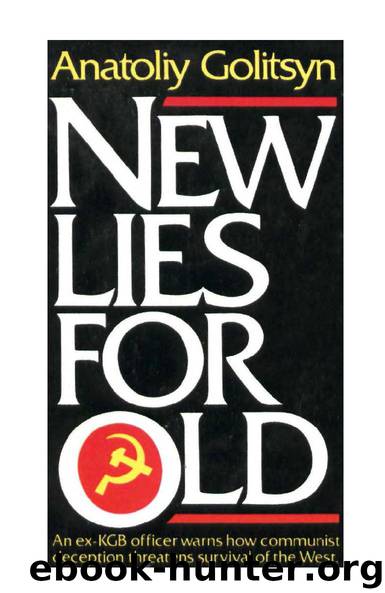
Author:Anatoliy Golitsyn
Language: eng
Format: epub
Tags: History, Unread, Nonfiction
Publisher: Dodd, Mead & Company
Published: 1984-03-02T07:00:00+00:00
Khrushchev's "Removal" an Agreed Transfer of the Leadership to Brezhnev
The view that Khrushchev was removed in a palace revolt is probably mistaken; it is not supported by the available evidence. In 1964 the situation differed radically from that in 1924 or 1953.
After Khrushchev's departure from the leadership, there was no political vacuum. The same united team of active Khrushchev supporters carried on. The internal crisis of the regime and the problems of intrabloc relations had been solved. The long-range policy for the whole bloc had been adopted and was in operation. There were no grounds for expecting political crisis or power struggle.
The tragic consequences of the two previous succession crises were not lost on Khrushchev and the other Soviet leaders. Lenin's death had been followed by the liquidation of a generation of party leaders, by mass repressions in the party, and by splits in the Communist International and its affiliates. The struggle after Stalin's death had delayed the formulation of a long-range policy and threatened the continued existence of the communist bloc. It was vital that there should be no further repetition of these disasters.
In 1964 favorable conditions existed for a calculated transfer of power by Khrushchev to a leader or group of leaders of his choice because of the existence of collective leadership, as practiced under Khrushchev since 1959; the increased influence of the Central Committee and party apparatus; the absence of opposition in the leadership; the greater stability of the regime; improved relations with the leaders of other communist countries; the establishment of collective leadership in the Chinese party under Mao; and, above all, the adoption of the long-range policy. Khrushchev had a personal interest in the implementation of this policy through his successors because it was adopted during his rule and with his active participation. His role in its initiation offered him promise of greater posthumous respect and recognition than Stalin had been accorded, for all the power and glory of his reign.
In his concern for long-range policy, Khrushchev would naturally have considered the question of succession. He was in a perfect position to arrange it, since he controlled the situation in the party and the government and he had time in which to act. He had packed the Presidium and the Central Committee with his men; he had his nominees in the KGB and the army and at key points in the party and government apparatus; he retained his own leading position in the party secretariat, the Presidium, and the government. In the light of his claims to be another Lenin, it seems likely that he gave serious thought to the problem, as Lenin did in 1922-23. Following Lenin's example, he probably made recommendations to the Central Committee in the form of secret letters or speeches on the eve of the Twenty-second Party Congress.
Such indications as there are support the conclusion that he was thinking about and acting on the succession problem on the eve of his "removal." Signs of this can be detected from the Twenty-second Party Congress in October 1961 onward.
Download
This site does not store any files on its server. We only index and link to content provided by other sites. Please contact the content providers to delete copyright contents if any and email us, we'll remove relevant links or contents immediately.
| Anarchism | Communism & Socialism |
| Conservatism & Liberalism | Democracy |
| Fascism | Libertarianism |
| Nationalism | Radicalism |
| Utopian |
The Secret History by Donna Tartt(18971)
The Social Justice Warrior Handbook by Lisa De Pasquale(12172)
Thirteen Reasons Why by Jay Asher(8856)
This Is How You Lose Her by Junot Diaz(6845)
Weapons of Math Destruction by Cathy O'Neil(6225)
Zero to One by Peter Thiel(5743)
Beartown by Fredrik Backman(5691)
The Myth of the Strong Leader by Archie Brown(5474)
The Fire Next Time by James Baldwin(5395)
How Democracies Die by Steven Levitsky & Daniel Ziblatt(5183)
Promise Me, Dad by Joe Biden(5120)
Stone's Rules by Roger Stone(5060)
A Higher Loyalty: Truth, Lies, and Leadership by James Comey(4920)
100 Deadly Skills by Clint Emerson(4888)
Rise and Kill First by Ronen Bergman(4747)
Secrecy World by Jake Bernstein(4710)
The David Icke Guide to the Global Conspiracy (and how to end it) by David Icke(4664)
The Farm by Tom Rob Smith(4475)
The Doomsday Machine by Daniel Ellsberg(4463)
